“What’s your definition of war?”
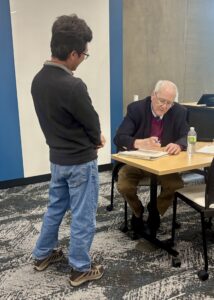
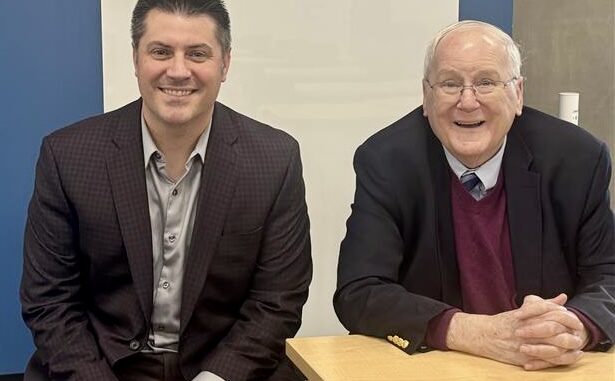
As part of DMACC’s War and the Human Experience speaker series, Ambassador Kenneth Quinn directed that question to a crowd of over 50 people—students, professors, and the public—when he visited the Urban Campus on Oct. 30.
Ambassador Quinn even admits that he himself didn’t have a definition, until he was invited to speak about his experiences as a diplomat during the Vietnam War. Referring to everyone impacted by war, he said, “[it] all comes down to one question; to whom do I have an obligation?”
History Professor Walsh coordinates speakers for this series including last year’s Bosnian war survivor Emma Dedic-Sakanovic and Air Force veteran Tony Marshall. He said, “I believe it is a part of being a good citizen. You need to understand America’s conflicts past and present, what’s going on in the world, and what’s America’s role. That’s something I’m interested in having students learn about.”
Speaking of hazards that are still scattered across Vietnam, like landmines being accidentally set off by locals or the lasting effects of chemicals like Agent Orange, Ambassador Quinn said, “If you don’t know, and if you don’t take away anything else from this morning, I want you to take away this one fact. Which is that 50 years after the end of the Vietnam War, April 30, 1975, … the last casualty of the Vietnam War is yet to take place.”
Ambassador Quinn asked, “For your generation, watching the terrible conflict in Gaza and Ukraine, 50 years from now in 2075 when Dr. Walsh has grey hair and you all are coming back, … will it be that the last casualty of the Gaza conflict, and the last casualty of the Russia-Ukraine conflict has yet to take place?”
Ambassador Quinn explained how he became a diplomat, what that experience was like for him in Vietnam, and how he decided to stay in Vietnam after being offered a reassignment.
He worked to accelerate the amount of rice farmers could grow in Vietnam and talked of some success, saying the rice seeds that the US brought could yield three times as much as rice and that farmers could harvest twice instead of the one time they were used to.
Ambassador Quinn also told a story of when he, his wife, and their three children were attacked in Cambodia, where their house was bombed and under prolonged fire. Speaking of the moments where he was laying on top of his family to protect them, he said, “Please God, let the bullets coming in kill me, and not my children. It’s when you discover how intently you love your children, you discover how much our parents must have loved [us].”
Walsh said, “I know DMACC is a military friendly college and this is a core aspect of that. We want to respect our veterans and learn more about their experiences. At Urban Campus in particular we have a lot of students who are refugees or have experienced war and it’s an important topic to cover. We have all the current events going on that Ambassador Quinn mentioned, the War in The Middle East, the situation in Ukraine … it’s something we should study.”
Spanish Professor Carrie Morris said, “It’s a fantastic opportunity to have Ambassador Quinn on Campus at DMACC at Urban. I especially think foreign service is a really important time in any time, not just these days. But seeing the world, learning about the world, learning languages and other cultures has big impact on the decisions of the future of this country.”