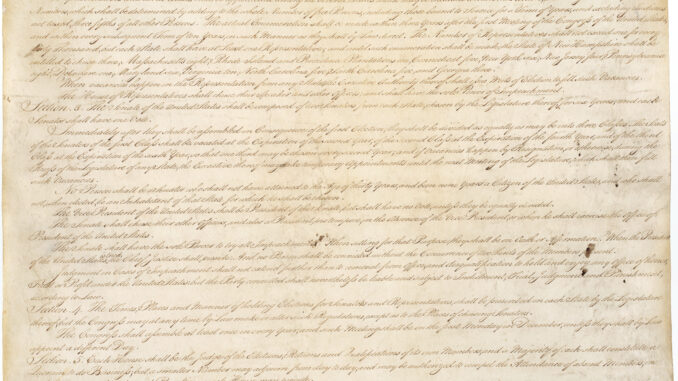
Constitution Day isn’t widely celebrated like Independence Day or Memorial Day. For some, those holidays consist of family time, hot dogs, or visiting passed loved ones. These three holidays carry some of the same components of patriotism and thankfulness. But for DMACC students, this year, celebrating Constitution Day meant joining a virtual meeting on Sept. 17, 2025.
This free event was open to both students and faculty members of DMACC. Pathway Academic Chair for the Education, Communication, and Humanities Bethany Sweeney presented a selection of constitutional amendments that shape how America runs today. She discussed details of cases like Obergefell v. Hodges.
Sweeney introduced different ways people choose to interpret the constitution by providing examples and contexts. She shared several constitutional interpretation theories like Textualism, Originalism, and Living Constitution.
DMACC History Professor Matt Walsh said, “Professor Sweeney articulately explained how freedoms can clash: the LGBTQ couple’s right to marry versus the baker who refused to provide a wedding cake to that couple on religious grounds.”
Sweeney made the content of her presentation relevant by sharing historic court cases and how they are applied to current cases. The topic of Freedom of Speech had a notable mention of Crown v. Zenger. Zenger’s lawyer in the case was Andrew Hamilton. After Freedom of Speech, Sweeney talked about imminent lawless action. In relation to recent events, she referred to the ongoing discourse connected to the assassination of Charlie Kirk and how legal repercussions for different kinds of speech on public platforms work in the court system.
Sweeney included links to stories connected to United States citizens who have faced scrutiny online or in the media about their comments on the death of Charlie Kirk, some of them being educators and Iowans.
After her presentation, she opened the meeting to questions and answers. Attendees jumped in with a variety of questions both in the chat and as part of a larger discussion.
“I decided to do this lecture this year because I thought, given our tense political climate, that it was important to highlight the rights the Constitution protects and how those rights have been interpreted by the courts,” Sweeney said. “I wanted people to have a chance to hear these issues discussed, to ask questions, and to know that it’s important to continue talking about the complex issues that our society faces even when such conversations are difficult.”
The invitation to the Constitution Day event was sent out via email the day before. Even with the short notice, a total of 35 accounts attended the meeting—many signed in by themselves and several with classes or clubs. DMACC has hosted Constitution Day events since 2005.
Walsh said, “The presentation was well done. [I] enjoyed the inclusion of landmark Supreme Court rulings from the past, and recent events like the Kirk assassination and questions about free speech of employees.”
Correction: An earlier version referred to Zenger’s lawyer as Alexander Hamilton, but it was Andrew Hamilton.